

I saw this book on Eleventh Stack earlier this month and decided that it might be the perfect read for the holiday season. We’ve been reading A Christmas Carol by Charles Dickens on Periscope, so this seemed to be the perfect foil to the original story. I still feel that way now that I’ve listened to it. This book is written by Joel Waldfogel, an economist whose specialty seems to be investigating something called dead weight loss. Or, more generally, the efficiency with which resources are put to use. In the book he lays out an argument for more efficient gift giving (or not giving).
The argument goes like this: I give you a sweater worth 50 bucks but you only get 20 bucks worth of enjoyment out of it. My gift of that sweater destroyed 30 bucks worth of value. Or, worse: I give you a sweater worth 50 bucks but you enjoy it 20 bucks worth. However, you would have bought yourself a different $50 sweater that would have given you $80 worth of enjoyment, so now the $50 sweater gift destroyed $60 worth of value (what you would have enjoyed minus what you are enjoying). Waldfogel walks us through all different ways that value can be measured and how economist collect and analyze that data. He also discusses what that means, not just for gift giving, but also for giving to charity and government spending (which he used as examples).
The book was really heavy on data, so be warned. More than a few reviews on goodreads panned it because it had too many numbers in it. (Personally, I would have been disappointed with fewer numbers. The book was written by an economist and published by Princeton University Press. Knowing those two facts, I expect to see a lot of data.) But, Waldfogel made some really great arguments for being thoughtful about what you give to whom, and I liked that. He also made some great suggestions for how to give more efficiently. One of the suggestions that he made was using the holiday season to give through people instead of to people. Which is to say: giving a gift in the name of someone to a charity or an organization. One of the things that we can do is give people money to give to charity. He hypothesized a charity gift card scheme that I haven’t seen but I do hope to eventually see. The idea would be that you’d give someone this charity gift card that they could then log into a website and give to the charity of their choosing. What a beautiful idea.
To bring this back to Scrooge and A Christmas Carol, what this book kept making me think about was the value and usefulness of something. And, this is a message that also keeps coming up for Scrooge in A Christmas Carol. Twice now in the story so far (if you’re keeping up with us on periscope or katch), Scrooge has been confronted with something from his past or his present that made him rethink the value of something or someone in his life. Remembering what it is like to be alone at the holiday season makes Scrooge wish he’d been kinder to a caroler. Seeing exactly who the ‘surplus population’ is makes him regret his callous statements about the poor. Gift-giving is wonderful and provides us an opportunity to let people we care about know that we appreciate them. And, as Waldfogel points out, in many instances it is mandatory. You can’t not give a gift to your mother-in-law just because you don’t know her very well and you think anything you’d give her would just be wasted. So, since you have to give, strategies for how to give better can only be a good thing. We can be thoughtful about how we give when we give so that, in general, some good comes from our giving. The goal isn’t to hoard, but rather not to waste.
I enjoyed this book immensely, and if you’re interested in the economics of giving, you might want to give it a spin.
I got this book from audible.com
 There is so many things to love about this book and this series in general. It’s beyond funny. Sophornia is in finishing school but it’s not just any Victorian age finishing school. Yes, Miss Geraldine’s teaches her girls how to behave like a lady and how to land a good husband but also how to kill them too. Miss Geraldine’s develops the best lady intelligencer’s in the majesty’s realm. Sophronia and her friends may still be students but they are all that stands in the way from the evil Picklemen taking over the realm and keeping peace with the vampires and werewolves. So don’t take these girls lightly. They may have all the charm and manners of a lady of quality but that only makes them more deadly. If there was one downside to this and that it needs more Soap. Soap is Sophronia’s one true love. In a world where social class is important, they are a forbidden match. Sophronia doesn’t come from most wealthiest of families but she is expected to marry a certain class of gentlemen and a black sootie is not that class. At the end of the last book he is turned werewolf to save his life. In this Steampunk London, supernaturals are granted equal footing with the upper class but he’s still the wrong race and well now the wrong species. His role is a little lesser then in past books since he is no longer at the floating school. He is not really given much to do but he does make the most of the time he does have. All and all it was a good ending to a great series. I’m going to have to read Gail’s other series that take place in the same world because if these are any indication, they will be a hoot.
 This is it. I don’t want to say that this will be the last time I read Winter or The Lunar Chronicles but I am ready to move on. This was a very lovely series that was just fun to read. So here we go. My last few observations
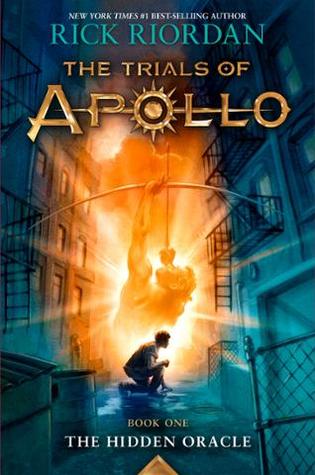 We are big fans of Rick Riordan here at Stacks so we or at least I am since Kate has yet to finish Blood of Olympus (and I will continue to publically shame her until she does, out of love of course). We saw that USA TODAY published the cover to the first book of Rick’s new series The Trials of Apollo: The Hidden Oracle. The series is a small spoiler as to what happens to a certain God at the end of the last series but then again, if you know your Greek Mythology then you know that Apollo has a history of pissing off Zeus and that he gets turned into a human. The most exciting part of all of this is that it returns us to Percy Jackson’s world and another trip to Camp Half-Blood. Rick may explore other mythologies like Egyptian in the Kane Chronicles and Norse in his latest Magnus Chase and the Gods of Asgard but he always seems to come back to Greek mythology and Percy. USA TODAY not only revealed the cover but also
  2 Women, So Many Books