Supporting Small Presses

Last year, completely by accident, I discovered that small presses sometimes offer subscriptions. What better way to support books, publishing and literacy? You buy a subscription and they send books as soon as they come out! Amazing!


So, I did some googling around and here are three small presses who offer subscriptions.


Sibling Rivalry Press is a publisher of poetry. They are a publisher devoted to “[promoting] underground artistic talent – those who don’t quite fit into the mainstream.” I’ve not read anywhere near enough of this year’s subscription, but everything I’ve read I’ve really enjoyed.


Above/ground press seems to have their fingers in a lot of different publishing pies. (That’s exciting if you, like me, like to read around.) Their subscription includes a number of different types of things (chapbooks and broadsheets and who knows what else?) It seems pretty cool.


Burrow Press‘s subscription includes their physical books, ebooks and a membership pin. There are four titles listed at the link that are slated to come out in 2017 and who knows what else will be added?


The only one that I have subscribed to before was Sibling Rivalry and that was delightful. The other two look pretty good as well. Have you done a subscription to a small press before? Did you like it? Do you have any subscription suggestions for us? Take to the comments and let us know!


This Month in Reality: Book lists and Syllabi

A lot of terrible things have happened…well, all of human history might accurately categorized as action and reaction when terrible things happen. One of those actions that people can take is educating oneself and trying to be a better person and/or not be as much a part of the problem. I have been heartened to see what might be a new trend in book lists: the syllabus. (Can a tool for teaching in the classroom be thought of as a “new” trend out of the classroom?) I am always happy to see thematic lists and I’m always looking for new things to read, so I have been collecting them. Some of the following are actual syllabuses for college courses and some of them are just curated lists on a topic. I’ve got them and I’ve been looking back through them now that I’m aware of how far behind I am on my reading challenge. While I was looking at them, I thought I might share them with you.

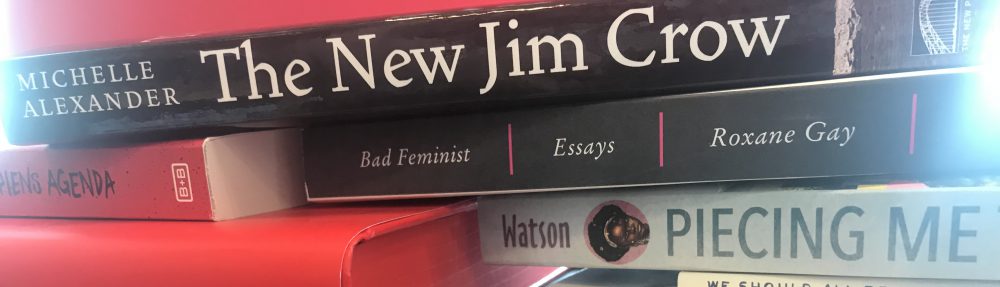
This first link is an in-depth list but together following the mass shooting in Charleston in June of 2015. This list is amazing in its detail. It provides historical context starting with a general overview before readings on slavery in both the North and the South before going onto the civil war, reconstruction, and Jim Crow. There are readings on race and religion. There are readings on white identity construction and white supremacy in the US and abroad.

The next syllabus I have to offer is the Black Lives Matter 2016 Fall Syllabus. This syllabus was put together by Professor Frank Leon Roberts at NYU for a class. This is a nice syllabus because it includes not only papers and texts to read but it also includes videos and films to watch. The syllabus also includes writing prompts for reflection papers, so while you are reading and watching, you can also do some digesting.

The Standing Rock Syllabus, put together by the NYC stands with Standing Rock collective includes readings on topics like settler colonialism, the histories of indigenous peoples in North America, environmental racism, and readings on Indian sovereignty and treaty law.

The Lemonade syllabus grew out of a desire that many people had to understand and better get all of the references in Beyonce’s visual album Lemonade. It was put together by Candice Benbow and is beautiful. It is stunningly laid out, once you’ve followed the link from the site. It is 36 pages and includes space to make notes and to write down the date when you finished reading. The syllabus is divided into topics that include (but are not limited to) fiction, non-fiction, black feminism, womanist theology, photography, music, critical theory and poetry. It is so cool. People had questions, they took to twitter and using a hashtag gave each other answers.  I cannot understate how in awe of this syllabus I am.

The Luke Cage Syllabus is a look at the literature in the netflix show Luke Cage but together by Tara Betts at Black Nerd Problems. These are books that are seen or referenced in the show. This syllabus is my convenient excuse for re-watching the show.

These last two I haven’t had a lot of opportunity to look over yet. One of them is a google doc and I’m not sure who it is edited by but it is a reading list for white people who want to educate themselves so that they can be more informed. It is divided up thematically and includes readings on systemic racism and racist ideology, the history of black lives matter and readings on steps you can take to combat racism. The last one is from Haymarket books and is called the Stop Trump Reading List. This list contains books that talk may help you understand how Trump was elected and it includes a link to a list of books especially for young people.

So, there you have it. Syllabi and reading lists to help you find your next book(s) and  to learn a little about issues in the world and also about references in pop culture you may be missing!

If you have any suggestions or have seen any reading lists/syllabi out there that I missed, please take to the comments and let me know!
 

Another Diverse Stacks, Diverse Lives Challenge Update

Beth already did a challenge update this month and with a little over a month left in 2016, I thought I should see where I stand.


bookchallenge2016image


In June, with about half the year under our belts, I had read six books off of the challenge list. Six books. Off my own challenge list. Ugh. I am the worst.


So, let’s see how well I’ve done since then. To The Raven King, The life-changing Magic of Tidying Up, The Year of Yes, Sad Girl Poems, the Feminist Mystique, and A bunch of Captain America, I have added: Americanah, Kindred, Bitch Planet, The Absolutely True Diary of a Part Time Indian, Whipping Girl (in progress), Call Me by My Other Name (to be reviewed), and Emperor of Sound.

So far I’ve read 13 out of 30. As I don’t like failing at things I set out for myself, I have thought about rearranging the things that I’ve read this year on the list so that I can use things that aren’t currently on the list so that I can satisfy categories I haven’t gotten yet. Like, if I moved Shonda Rhimes to “read a book by a woman of color” then I could put Caitlin Moran in at “read a book by a woman”. But, I read Shonda Rhimes book first, so it is staying where it is. The good news for me is that I have another six categories already picked out. The even better news is that I’m part way through two of those books. However, there’s still a lot of work that has to be done in 2016 and, I have to tell you, folks. I’m not feeling sanguine about meeting the challenge this year.


We Stand with Standing Rock


We here at Stacks Exceed Life Expectancy are very grateful for all that we have. We’re grateful for each other. We’re grateful for the roofs over our heads. We’re grateful for all of our stacks of books and for having lives that allow us the time to read from time to time and tell people about it. While it is easy to be grateful and we could choose to focus on this gratitude and our own lives today, we find it hard to do that with everything going on in the world. Specifically, everything going on at the Standing Rock reservation in North Dakota. So, we would like to take today and say that we stand with Standing Rock. The Water Protectors deserve to have their rights to clean water acknowledged and upheld and the police presence that has been doing things like shooting water canons at Water Protectors in below freezing temperatures are wrong for what they are doing. It needs to stop.

So, today, we are also very grateful for everyone who is working to protect the land and its resources. We are also grateful for everyone who has stood with them,  either by physically going or by donating resources. Please consider donating to help support the Water Protectors of the Standing Rock Sioux on this day of thanks. That is a link to the fund supporting the medical and healer tent. You can also donate items off of Medic and Healer Tent or the Sacred Stone Camp‘s amazon wishlists.


They are doing good work to ensure that people are taken care of.

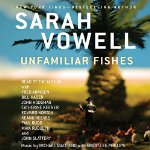
Review: Unfamiliar Fishes by Sarah Vowell

I have become one of those people who decides to read a book, checks the library for it, and then if A. the library doesn’t have it or B. the waitlist is longer than my patience, then I buy it. This isn’t something I do to be virtuous. This is something I do to curb the rate at which I acquire books. Because I own an obscene number of books. And, I pick them up at library sales and bookshops like they’re going out of style. I can’t seem to help it. As an audible subscriber, this means I often have more than one credit in my bank. If the library has it, I check it out. I listen to a lot of audio books, so this is a good system for me. But, having a surplus of credits is often a problem (is it, though?) I have. Audible has a solution for that. They have 3-for-2 sales pretty frequently and I end up picking three things that seem interesting but I don’t always pay really close attention to what they are about. This is how I ended up with Unfamiliar Fishes by Sarah Vowell. I had read other Sarah Vowell books before and enjoyed them and I needed a third book.


51s1i4g9ctl-_sl150_


I had no idea what it was about (or, at least, I didn’t remember what it was about) when I started listening. It is the story of how Hawaii came to be a state. It is an interesting look starting with traditional Hawaiian culture, looking at the influence of colonial powers, business interests, and religion, and ending with the coup staged by the “Committee of Safety” in 1893 and the subsequent dancing around that eventually ended up with the US taking over Hawaii.


It was a really interesting story and one I probably wouldn’t have listened to otherwise. When I think about the American history that I was taught growing up, they really didn’t cover the colonial expansion that netted us Guam, American Samoa, and the Philippines for awhile. Thinking about this expansion and who has rights to what territory seems particularly important now as we currently live in a world where the Standing Rock Sioux are peacefully agitating for their water rights and getting nothing but hell for it. Vowell’s book is thoughtul, well laid out and tells a believable tale about how a people can change based on the influence of those they come in contact with and how other people can use those changes as an excuse to be more involved (and then eventually take over). I’m pretty happy I listened to it. Additionally, the audio format allowed for a really fun presentation. Vowell reads the main body of the text and has other readers in to play historical figures. Why read a quote from Teddy Roosevelt when you can John Hodgman do it? In addition to hearing Vowell, you also get to hear Maya Rudolf, Catherine Keene, John Hodgman, Fred Armisen, Bill Hader, Keanu Reeves, Paul Rudd, and John Slattery.  At one point while I was listening, I actually said out loud, “Oh, no! Paul Rudd, you sound like a racist d-bag!”


This book is for you if you are interested in American history and you are ready to hear about America’s colonial expansion through Sarah Vowell’s dry humor. If you’re not American history, dry humor, or feeling a little uncomfortable (if you’re an American) then this book is maybe not for you.

The Elements of Style by William Strunk and E.B. White

9780205309023_p0_v4_s192x300


Do you know where to put commas? Semi-colons? Do you know how to use a hyphen? Well, Strunk and White are here to help. In my life away from this blog, I am a linguist. Linguists, in general, are more about describing language as it is than telling you how to language right. And, I’m into that. I think that is a good thing. But, it definitely has its place. We do all still have to communicate with each other, sometimes in sentences with multiple clauses. When we talk to each other, we can use intonation to indicate clause breaks. We make little pauses. The pitch of our voice rises and falls. But, in writing, we can’t rely on that. We need a way to indicate where the pauses to be. Strunk and White lay out the details by giving you a guideline and then showing you a couple of examples. It is a basic guide that covers a lot of the trickier uses of punctuation. It is a nice little guide for getting your commas straight.


Review: How to be a Woman by Caitlin Moran

9780062124296_p0_v1_s192x300


I wanted to like this book. I really, really did. And, to start off with, I did. She was very funny when she talked about growing up. She said some true things about how young girls and women are treated. She was very funny talking about interacting with men, her jobs, and her marriage and children.


And, then she went completely off the rails by defending women’s bodies and then turning around in the next paragraph and shamed certain bodies. In the span of one paragraph, I went from totally being into this book to deciding I was pretty done with it.

Here’s why fat-shaming in the middle of a feminist book is a problem: Feminism should be about fighting for the dignity of all humans. We deserve our dignity regardless of our gender, race, religion and sexuality or whether we are cis or trans. We deserve our dignity regardless of whether or not we are healthy or perceived to be healthy. Human dignity and human rights are not up for negotiation. I may have read a few chapters beyond the fat-shaming, but I’m not sure I finished this book. I wanted so badly to like this book because it was on Emma Watson’s feminist book list. But, I also wanted this book written by a woman not that much older than me to be a little bit more aware of feminism is for all women and not just for women who are like the author.

So, 2 out of 10, do not recommend. Unless you are a lot more forgiving than problematic feminism than I am.

The Monuments Men by Robert M. Edsel

9780316240055_p0_v2_s192x300

I picked up this book in a sale at the library. It seemed like it might be pretty fun. Well, as much fun as you can have in a war. Nazis steal treasure (from pretty much everywhere) and Allied soldiers get a wiggle on and go after it. The narrative starts prior to World War II with members of the art community saying that war is bad for art and that we should remember that if fighting ever happens again. It followed the stories of a couple of museum people and some art conservators. One of them actually writes out a plan on how to preserve monuments and art during wartime. Then, World War II breaks out, the Allied forces have some pretty disastrous PR following the destruction of some monuments and so decide that maybe they should do something to preserve the cultural heritage of Europe. This turns out to be a great idea because Hitler is obsessed with art and has his surrogates all over Europe cataloging and seizing all kinds of property.

So, this book follows six of the folks assigned to Monuments duty during World War II. The bulk of the narrative focused on the recovery of the Ghent altarpiece, the art at Neuschwanstein Castle and all of the art that was stored at the salt mine at Altausee. It was really interesting hearing about all of these pieces of art. It was also interesting hearing about the storage, transportation and care of the art. (Spoiler Alert: pieces often didn’t get the treat they deserved.)

I’m not going to lie to you, some of this book was a little boring. But, overall I’m glad that I read it.

So, if you’re interested in war, treasure hunting and the Allied forces defeating the Nazis, you may want to pick this up.

Review: We Have Always Lived in the Castle by Shirley Jackson

This was a book I read for my book club. It is about Merricat, Constance and Uncle Julian Blackwood. They are the last the illustrious Blackwood clan. They live in the family manor. Constance has not left the house in six years and Uncle Julian is in a wheelchair because of a terrible incident that has befallen the family.

Merricat goes to the store and the library once a week. But, everything is about to be turned on its head.

The incident that befell the family is that the rest of the family was poisoned and Constance was put on trial for their murders. Uncle Julian is in his wheel chair because of the poisoning incident. They are visited by Cousin Charles, who befriends Constance. They start to talk about Constance trying to reintegrate into society. From here a chain reaction of sorts leads to the revelation of who really killed the rest of the Blackwood Clan and why. This all leads up to a second incident that changes their lives forever.


At first, I wasn’t into this novel. But, the more I read it, the creepier and more interesting it got. It was a fun little read.


So, if you’re interested in families with secrets, sympathetic magic, and creepy narratives, I recommend you pick this one up.