Beth and I saw Harry Potter and the Cursed Child Parts 1 and 2 this week on Broadway! It was an exciting, if long experience. The play takes place after the final scene of the seventh film. We’re going to keep this review spoiler-free. It was an experience and definitely worth seeing, if you are a huge Harry Potter fan. We don’t want to ruin the magic for anyone.
What was your favorite part?
Kate: The magic, maybe. I think they did a great job making the stage really feel like the wizarding world.
Beth: Agreed. The stage craft was on full display. How they were able to create the feel of the wizarding world without special effects of the movies was very impressive.
What about the costumes did you like?
Kate: I want capes to be a thing in everyday life now. There is just so much drama and flair in wearing a cape. I could use a little more flair in my life.
Beth: OMG! The Capes! The way they moved and swayed I’m so jealous. We should bring back the capes.
What did you like about the staging?
Kate: The special effects were really neat but they didn’t distract from the story. I really liked that.
Beth: I thought it was so well done. I loved how they did the moving stairs.
Kate: OMG! The stairs were so good! I liked how the stairs and the movement made the space feel so much bigger and more dynamic!
Who was your favorite character?
Kate: Scorpius Malfoy, hands down. He was amazing. Draco comes in second, but possibly only because I was really impressed by how much his character developed from when we last saw him at Hogwarts.
Beth: Yeah! Who would have thought that a story with Harry, Hermione and Ron that Draco and his family would turn out to be the most likable. Scorpius was the real heart of the story. He brought most of the laughs and kept the story going. I’m hoping that if they do a new movie series after Fantastic Beast, it should be centered on him.
Kate:I would watch Scorpius Malfoy movies. I love that little nerd.
Any last thoughts?
Kate: I still have some questions about various bits and pieces of the story. But, I really enjoyed the spectacle of it, so I’m willing to forgive (though, if you follow us on twitter, clearly not forget) some of the more plot-hole-ish things.
Beth: I’m with you on this. There were some pretty noticeable plot-holes that fans should easily notice and since I’m guessing that most people who see this are big fans, then we are not the only one who has issues with it. That being said, sitting in the audience with other people who came dressed up in their Hogwarts finest, made it more enjoyable. We all knew what was going on. We all got the easter eggs they dropped. We all gasped at the same time. It was like a community experience. Harry Potter fans, I think this is a must see (plot-holes and all) and theater geeks, too, because the staging is in a class of it’s own.
Kate:It was so good to see people turned out in their Hogwarts finest! You are so right! I loved seeing everyone’s outfits! And, everyone who turned up in their cape in August, I have so much respect for that. It must have been so hot.

 The last book of my
  My pop culture assignment from
 I’m not sure where to begin because there is so much here and hard to explain. The assignment is examine how Ursula K. Le Guin uses language to tell her story. The language is very lush and full of descriptions of the strange world of Winter. A harsh world that is like living on the Artic in our world. The people of this world are gender neutral and assexual for most of the life except for when they are in “kemmer” where partner with another person in “kemmer” and could be female or male depending on things went. They could be the a father to one child and mother to another. Le Guin uses the “he” pronoun for all the Getheren even though they are not male or female. I believe it was used more simplistic reasons then insinuated that they are more male most of the time then female. It was hard as the reader to understand that, that when “he” was being used it wasn’t that the character was a male but a Genthen.
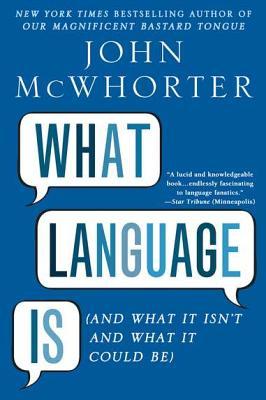 You know when you meet someone who loves what they do so much that when they talk about it they get so excited about it even though you have absolutely no idea what they are talking about but you are so taken in by their enthusiasm that it doesn’t matter. This is often how I feel when Kate talks about Linguistics. She gets so excited and her face lights up and it’s just so Kate that I want to know what she’s talking about and be just as excited as she is. John McWhorter is the same way. I can feel his excitement on the page as he talked about one language after another. I’ll admit that there were a few things I still don’t understand but I think I get the gist. It’s interesting on how languages evolve and change over centuries. Obviously I knew that the English we speak today is not the English that was spoken in Shakespeare’s day or even Chaucer’s but never really thought about it how we got to where we are now. Basically, adults needed to be able to communicate but were unable to grasp some on the complexities of the language so they simplified it and taught it to their kids and so forth and so on. It’s kind of amazing. I basically learned that the more people who speak a language over centuries, the less complicated it is. If you speak a language that only a few know and have all learned from childhood it’s going to be more complicated it because adults from the outside have little use to learning it to communicate it. I’m probably oversimplifying it but that’s fascinating. He makes arguments for what languages are categorized and how our own biases make us judge languages and what are real languages and what are not. Does it have to be written? Spoken by a certain number of people? Have it’s own grammar? Follow certain rules? All very interesting questions that I really can’t do justice answering but say read the book and get suck into his excitement and enthusiasm while you are at it.
