Beth and I saw Harry Potter and the Cursed Child Parts 1 and 2 this week on Broadway! It was an exciting, if long experience. The play takes place after the final scene of the seventh film. We’re going to keep this review spoiler-free. It was an experience and definitely worth seeing, if you are a huge Harry Potter fan. We don’t want to ruin the magic for anyone.
What was your favorite part?
Kate: The magic, maybe. I think they did a great job making the stage really feel like the wizarding world.
Beth: Agreed. The stage craft was on full display. How they were able to create the feel of the wizarding world without special effects of the movies was very impressive.
What about the costumes did you like?
Kate: I want capes to be a thing in everyday life now. There is just so much drama and flair in wearing a cape. I could use a little more flair in my life.
Beth: OMG! The Capes! The way they moved and swayed I’m so jealous. We should bring back the capes.
What did you like about the staging?
Kate: The special effects were really neat but they didn’t distract from the story. I really liked that.
Beth: I thought it was so well done. I loved how they did the moving stairs.
Kate: OMG! The stairs were so good! I liked how the stairs and the movement made the space feel so much bigger and more dynamic!
Who was your favorite character?
Kate: Scorpius Malfoy, hands down. He was amazing. Draco comes in second, but possibly only because I was really impressed by how much his character developed from when we last saw him at Hogwarts.
Beth: Yeah! Who would have thought that a story with Harry, Hermione and Ron that Draco and his family would turn out to be the most likable. Scorpius was the real heart of the story. He brought most of the laughs and kept the story going. I’m hoping that if they do a new movie series after Fantastic Beast, it should be centered on him.
Kate:I would watch Scorpius Malfoy movies. I love that little nerd.
Any last thoughts?
Kate: I still have some questions about various bits and pieces of the story. But, I really enjoyed the spectacle of it, so I’m willing to forgive (though, if you follow us on twitter, clearly not forget) some of the more plot-hole-ish things.
Beth: I’m with you on this. There were some pretty noticeable plot-holes that fans should easily notice and since I’m guessing that most people who see this are big fans, then we are not the only one who has issues with it. That being said, sitting in the audience with other people who came dressed up in their Hogwarts finest, made it more enjoyable. We all knew what was going on. We all got the easter eggs they dropped. We all gasped at the same time. It was like a community experience. Harry Potter fans, I think this is a must see (plot-holes and all) and theater geeks, too, because the staging is in a class of it’s own.
Kate:It was so good to see people turned out in their Hogwarts finest! You are so right! I loved seeing everyone’s outfits! And, everyone who turned up in their cape in August, I have so much respect for that. It must have been so hot.

 I was excited to read this book as the last book in the series Tiger’s Destiny came out 6 years ago. The Tiger’s Saga was about two Indian Princes and brothers who were cursed to live as tiger’s until one of the Princes meant a young girl from Oregon. Over the next four books Kelsey, Ren and Kishan go through many trials and tribulations to undue the curse and defeat the evil Lokesh with the help of Goddess Durga. From the beginning author Colleen Houck said there would be five books in the series so it was surprising that the end of Tiger’s Destiny seemed to have wrapped up the story. What did Tiger’s Dream have to offer? To say I’m disappointed would be an understatement. This is what we all waited for? There were several times that I thought about stopping reading because I got so frustrated. I found some of it to be very problematic and uncompelling. The rest of the review is going to be under the cut as it’s full of spoilers.
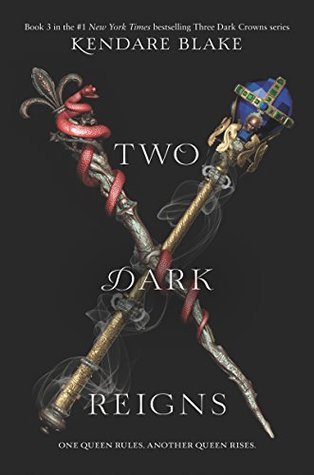 This series was originally planned to be only a duology. I’m glad that Kendare Blake decided to extended it two more books because it’s truly delightful. Two Dark Reigns begins a few weeks after the end of of One Dark Crown. Katherine is crown Queen of Fennbirn. Mirabella and Arisone escaped the island and trying to fit in on the Mainland. Jules is reeling from the death Joseph and is back and Fennbirn. The island is shielded by the Mist but the Mist is acting up and turning on the island. Probably because Katherine became Queen without actually killing her sisters and still possessed by the dead queens of the past. Her sisters escaped the Island and Jules is being propped up as the symbol of a new revolution. I still like the original Queens Katherine, Mirabella and Arisnoe and Jules is growing me but she’s still not favorite. Jules is legion cursed. Meaning she has two gifts that will make her crazy because her powers are so strong. This is partly why people think she is also a queen and that the Goddess of the Island is trying to change the bloodline of the Queens and change the course of the island. Of course the Island has another idea. Mirabella and Arsione may have escaped the island but the island isn’t finished with them yet. Arisone is being sent visions about the Blue Queen who created the Mist. She is haunted by her that forces them back. Jules and her new warrior friends are in direct conflict with each other. We still Queens against Queens but the battle lines are drawn and the fate of the island is at stake. Let’s just say, the last book is going to be a doozy.
 I read this as an ARC about a month ago. Thank you to G.P. Putnam for making it available to me to read. **May contain minor Spoilers**
 So I finally got around to seeing To All the Boys I’ve Loved Before on Netflix and it was delightful. It was every bit as charming as the book was and the casting was truly spot on. Lana Candor is the perfect Lara Jean. She’s sweet, shy and romantic. She’s unassuming and comfortable being in the shadow. Noah Centineo is the perfect Peter. He just oozes the big man on campus charisma. You can’t help but fall in love with him, which it seems like everyone on the internet has. The story is the same. Lara Jean is 16 and is about to start her Junior year in high school. Her big sister is going off to college making her the big sister at home. Her mother died when she was young so it was just her and her sisters and her dad. Lara Jean has never had a boyfriend but she’s had a few crushes. She wrote her crushes a letter that was never meant to be read until they were. Two of those letters went the Josh, the boy next door who dated her older sister Margot and Peter, her former friend from Middle School. Peter and Lara Jean decide to fake date to make Peter’s ex girlfriend jealous and help her avoid Josh. All goes well until of course she starts to have feelings for him. The movie goes by at a pretty clip. Establishing both Lara Jean and Peter and their relationship. As they spend more time with each other we see what a great couple they are for each other. They allow each other open up to each other and be honest about their feelings that they can’t be with each other. I also love that while Peter asks Lara Jean to do things outside her comfort zone like go to parties, he never asks her to change who she is. Obviously in the book we see more development of their relationship then we do in the movie because of time constraints it still comes out. They relationship may have started as pretend, you can see from the beginning that there was always something there. If there is one thing I wished there was more of was Kitty. Kitty was always my favorite character in the book and I think she needs her own series. *cough Jenny Han cough* I can only hope that Netflix greenlights a sequel so we get more of Kitty, Lara Jean and Peter in the future. The movie is not earth shattering but it is so cute and charming that i feeling it’s going to be on heavy rotation in my Netflix queue for now on.
 The last book of my
  My pop culture assignment from
 2 Women, So Many Books