I am definitely a Fantasy girlie and not so much a Sci-Fi. It’s not that I didn’t like listening to this book but I had trouble getting into it. Since I started listening to it, I started and finished three other books. It started out pretty good with scenes of the cultural revolution and then it moved to the modern day and I stopped kind of paying attention. I noticed that points in the book when characters started talking about different scientific theories, I started to space out and then I had to go back because I had no idea what was going on. I think when I finally started to get into it was more than halfway through when Wang was finally starting to get understand how to the play the game. I’m not sure I will read or listen to the other books but I want to watch the TV show. I’m not sure I’ll be rushing to read another sci-fi book anytime soon either.
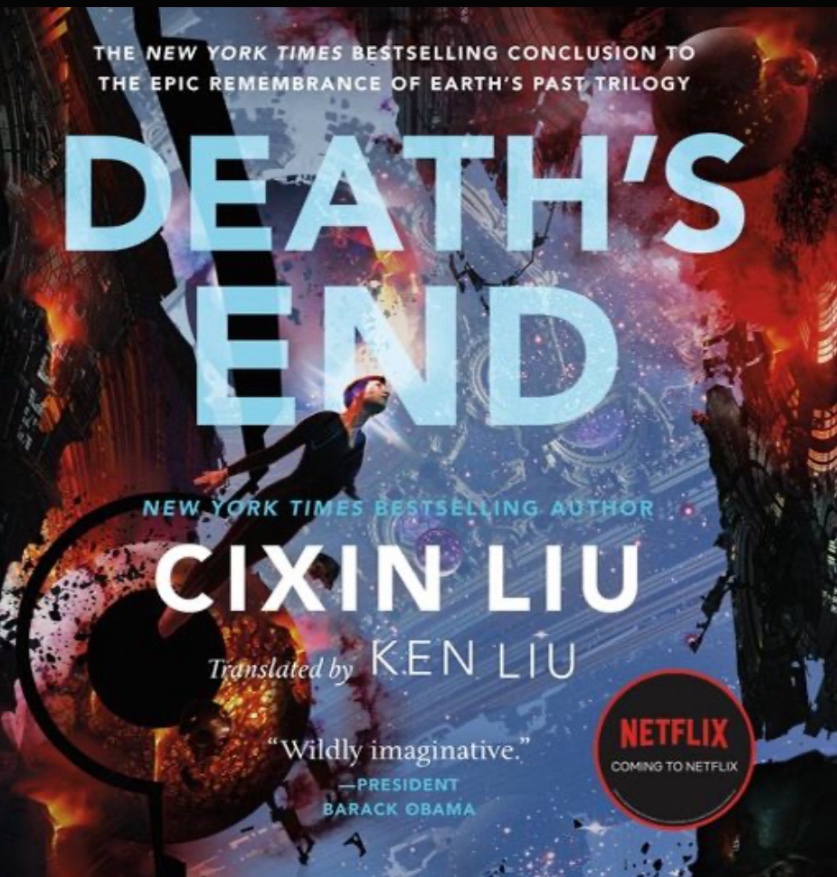
This post contains spoilers for the entire Three-Body Problem series by Cixin Liu: The Three Body-Problem, The Dark Forest, and Death’s End. So, tl;dr, if you like taking a long, dark look into the abyss and/or the human soul plus there are space ships, have at this series. If you like rocket ships and clear heroes and villains, and good triumphing over evil, this isn’t your series.
This book starts, of all places, at the Fall of Constantinople. It tells us the story of a prostitute who is able to assassinate even the most heavily guarded people. The end of her story is tragic, of course, but it serves as a fitting preamble to the rest of the book. The prostitute eventually fails because of a passing 4-D fragment in the solar system. We come back to the idea of multiple dimensions and moving between dimensions many times in this book.
So, like with the Dark Forest where we started back in the Crisis Era with the Wall Facer project, we do same with this book. While the Dark Forest followed Luo Ji as he figured out cosmic sociology and how to destroy other star systems, this book mostly follows Cheng Xin, a crisis-era scientist. She is just a regular person who happens to be a physicist when the Trisolaran plot is discovered. She is recruited by Planetary Intelligence. She puts forward an idea in a meeting that seems far-fetched. One way for us to get intelligence about the Trisolarans is to imbed a human in the Trisolaran fleet. This is exactly what her boss, Thomas Wade formerly of the CIA, wants. That’s not her crazy idea, though. Her crazy idea is to use all the nuclear bombs that we have lying around in precisely timed explosions to push a probe up to 1% of lightspeed. She is about to be laughed out of the room by the other scientists when Wade decides they should go for it. Onward, no matter the cost, as Wade likes to say. This becomes the staircase project and it ends up having profound effects on the fate of the whole solar system.
One of Cheng Xin’s friends from school, Yun Tianmeng has always had a bit of a crush on her and is dying of cancer. He unexpectedly receives a big wad of cash and, since he’s dying, he decides to spend it on an extravagant gift for Cheng Xin. He buys her a star, but he makes sure that she isn’t told who bought it for her. Then, he decides to end his own life. Before he can do that, though, Cheng Xin reappears and persuades him to stay alive long enough to become the spy they send to the Trisolarans.
Then we jump forward era to era to era, meeting characters we’ve met before and we follow a dance the Cheng Xin and Yun Tianmeng have with each other across literal centuries. Because of his gift of the star, Cheng Xin is put into a position again where she has tremendous power over the fate of humanity. This could go better, for her and for humanity. Because of decisions she makes, she is given two more chances to massively affect the fate of humanity. We meet Thomas Wade again as he tries to position himself to be a shot-caller. We meet Luo Ji again. There’s a complexity here that is interesting, and even though I said spoilers, I don’t want to be to spoiler-y. Thomas Wade comes off as a selfish-arrogant asshat, but for the whole of humanity, there is a definite argument to be made that he should be a shot-caller. Luo Ji seems pretty sympathetic to Cheng Xin and how love seems to be the principle that drives her, but he can also be a devastatingly effective critic. This book, like the ones before it, revisits over and over again the themes of humanity and love. What does it mean to be human? What will we do for those we love? What will we do to protect those we love? These are, as it turns out, not always fun and uplifting questions. Cheng Xin, Luo Ji, Yun Tianmeng, and the other characters in the book are repeatedly put into positions where there are no good choices and there is no way to stop the suffering. You just maybe get a little bit of say in the kind of suffering.
Another theme that comes up is arrogance. And how choices made in arrogance can way more destructive than choices made from ignorance or weakness. When we assume we’ve learned all we can learn from something, we might miss a detail that could save our lives. And, if you’re like me, you might end up yelling at an audiobook in your kitchen while you make dinner because someone decides, “We don’t know what that is. It’s probably unimportant.” But it is important. I’m still internally screaming.
These books were good, but they were dark. Like, I need some feel-good sci-fi after this. But I can’t wait for Beth to finish the series so we can talk about it. And I love a book that sticks with you. So, if you’re okay with dark, super-long delves into the heart of humanity on a very long timescale, then I recommend these. If you’re looking for a fun little jaunt into space, give this a pass.



 2 Women, So Many Books