Assigned Reading: Frankenstein by Mary Shelley and The Importance of Being Earnest by Oscar Wilde

Very occasionally, the interests of my work life and this blog align. This past year, it feels like that has happened more than any other time in career. I’ve been teaching some new-to-me courses in a different department than my home department, teaching some required general education Humanities courses. This has been delightful. I’ve gotten to interact with many students I would have never had the chance to interact with. And I’ve gotten to read (re-read) some classics, some foundational texts, and some big-named thinkers. The Humanities are important because we are important, to ourselves and to each other. These courses I have been teaching allow students to practice important skills around critical thinking and effective communication, but they also give them space to really consider big concepts that loom in the background of our days and define them for themselves. It seems silly to ask, in part because it is so ubiquitous, but what actually is ‘modernity’? Or, ‘progress’? How about ‘what does it mean to be American?’ But the answers to these questions can have very real world consequences. Definitions of modernity can classify useful and important things as out-dated and old-fashioned. For example, do students need writing skills or do they just need to know how to use AI templates? Definitions of progress can have huge impacts on what we require of students, what we expect from companies, what our government’s policy goals are. When we decide what counts as progress, we decide what our priorities are. For example, is generative AI progress? And for the impacts of what it means to be American, you can look at the headlines. The courts are debating who actually falls under birthright citizenship right now.

A man looks at his reflection in a pond. Text reads "Mary Shelley" "Frankenstein: the 1818 text"
Frankenstein by Mary Shelley

Two times this Spring, I had the opportunity to revisit classic works in the course of my teaching.The first is Frankenstein by Mary Shelley. I dug this out of the back of my bookshelves from when I was an undergraduate. This classic novel is a seminal work in sci-fi and horror and tells the story of Dr. Frankenstein, a man who never once stops to ask himself if he should, just because he can. I have discovered teaching this book (and from interactions that I’ve had with people on fable), that if your only reference to Frankenstein is pop culture, that you might be expecting this to be centered around the monster. And, it is, except the monster isn’t the creature. Dr. Frankenstein does this massively unethical breakthrough science and then fails, repeatedly, to take responsibility for the consequences of his work. Even though this was first published in 1818, it still feels very relevant to me. A perennial topic for opinion pieces (and for my student’s writing this past year) has been the cultural divide we are seeing and the idea that many of us are living in an echo chamber or are siloed off from ‘the rest of the world’. Dr. Frankenstein lives in this bubble where he thinks about his ideas and how to apply them and then doesn’t step back to seriously consider the implications of those applications. This is a theme that my students have been picking up on and that really resonates with them. It’s like voting for a politician because you like one idea that politician discusses without considering what that would actually mean for their own lives.
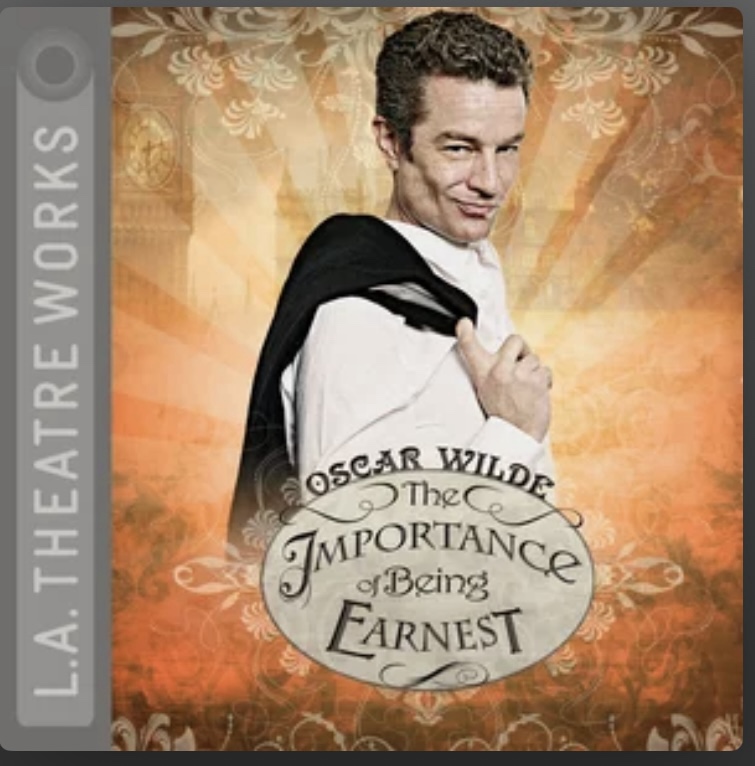
Man looks at the viewer with a jacket draped over his shoulder while facing right on a orange background. The text reads "The Importance of being Earnest. Oscar Wilde"
The Importance of Being Earnest by Oscar Wilde

The second overlap was The Importance of Being Earnest by Oscar Wilde. I listened to the L.A. Theatre Works production that I got from my local library.This is such a fun play as Wilde pokes fun at Victorian sensibilities and their obsession with appearance by punning off the word “Earnest”. In the play, two men discover that they are both playing similar games. They have a secret alter ego that they are always in need of rescuing that allows them to escape from the seriousness of their lives. This backfires a bit they fall in love with women who are both smitten with ‘Earnest’, one of the secret alter egos. This play is so silly and so fun, but it also something that my students have really enjoyed digging into. As largely members of Gen Z, they have grown up with the internet and very aware of what its like to live in a time that is utterly obsessed with appearance. For them, it might be how they express themselves on social media, but they still are able to draw parallels with the Wilde text.

It is a delight to be able to discuss reading with people who don’t always identify as readers themselves. Beth and I are obviously into reading for fun, but not everyone is, so their perspectives on classics are informed by other things beyond the written word. And it is always interesting to hear what people have to say about the connections they make between classics and their lives. It is also so important to connect with people and to think about big ideas. When we get caught up in the details of our lives (bills, health, jobs, family, etc.), we don’t always leave ourselves time to think about things and enjoy ourselves. But we should, because our humanity is important.

Weekend Reads: Body Parts

This theme just popped in my head and I couldn’t tell you why. I thought it and it made me giggle and now here we are. So, without further ado here are some recommendations for your weekend that all share a common theme, they involve bodies.

The Vagina Bible by Dr. Jen Gunter

Image of the cover of the vagina bible by Dr. Jen Gunter. Shows an open pink zipper with the title written over the top

Dr. Jen Gunter is (was? now that twitter is no longer twitter?) twitter’s doctor, especially when it comes to downstairs parts. This is a good resource to keep around. It dispels myths and gives you clear and forthright information about the vagina, vulva, uterus, and other bits.

Head On by John Scalzi

Black and White Cover showing a human figure missing its head and circle. The text reads "John Scalzi" and "Head On"

This is a standalone novel by John Scalzi related to another of his novels, Lock in. Set in a world where people with Haden’s disease become locked into their bodies and have to interact with the outside world through android, Chris Shane is an FBI agent and a Haden who is called in to investigate a Haden-related crime. This book was so good. There was mystery, politics, betrayal, characters you loved and characters you loathed. This is definitely something you can finish in a weekend. And you’ll want to. It was hard to put down.

Frankenstein by Mary Shelley

You know how I said that I had no idea where this theme came from? I think I have solved my own mystery. I assigned Mary Shelley’s Frankenstein to students taking a general humanities course about the modern world, which means I’ve recently re-read it. This is a classic for a reason. Science, madness, reason, love, hate, what does it mean to be human? What do we owe each other? There is so much in this classic.

Okay, so there you have it. Selections of pieces and parts. Have you read any of these? What did you think? What are you planning on reading this weekend? Sound off in the comments!

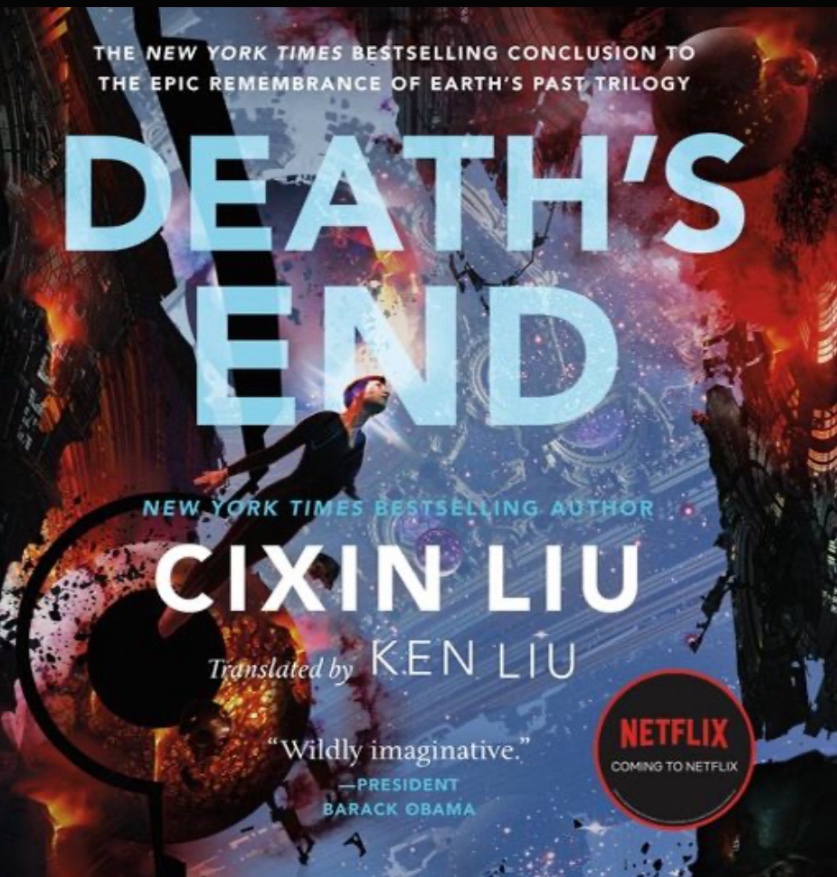
Review: Death’s End by Cixin Liu (Translated by Ken Liu)

This post contains spoilers for the entire Three-Body Problem series by Cixin Liu: The Three Body-Problem, The Dark Forest, and Death’s End. So, tl;dr, if you like taking a long, dark look into the abyss and/or the human soul plus there are space ships, have at this series. If you like rocket ships and clear heroes and villains, and good triumphing over evil, this isn’t your series.

This book starts, of all places, at the Fall of Constantinople. It tells us the story of a prostitute who is able to assassinate even the most heavily guarded people. The end of her story is tragic, of course, but it serves as a fitting preamble to the rest of the book. The prostitute eventually fails because of a passing 4-D fragment in the solar system. We come back to the idea of multiple dimensions and moving between dimensions many times in this book.

So, like with the Dark Forest where we started back in the Crisis Era with the Wall Facer project, we do same with this book. While the Dark Forest followed Luo Ji as he figured out cosmic sociology and how to destroy other star systems, this book mostly follows Cheng Xin, a crisis-era scientist. She is just a regular person who happens to be a physicist when the Trisolaran plot is discovered. She is recruited by Planetary Intelligence. She puts forward an idea in a meeting that seems far-fetched. One way for us to get intelligence about the Trisolarans is to imbed a human in the Trisolaran fleet. This is exactly what her boss, Thomas Wade formerly of the CIA, wants. That’s not her crazy idea, though. Her crazy idea is to use all the nuclear bombs that we have lying around in precisely timed explosions to push a probe up to 1% of lightspeed. She is about to be laughed out of the room by the other scientists when Wade decides they should go for it. Onward, no matter the cost, as Wade likes to say. This becomes the staircase project and it ends up having profound effects on the fate of the whole solar system.

One of Cheng Xin’s friends from school, Yun Tianmeng has always had a bit of a crush on her and is dying of cancer. He unexpectedly receives a big wad of cash and, since he’s dying, he decides to spend it on an extravagant gift for Cheng Xin. He buys her a star, but he makes sure that she isn’t told who bought it for her. Then, he decides to end his own life. Before he can do that, though, Cheng Xin reappears and persuades him to stay alive long enough to become the spy they send to the Trisolarans.

Then we jump forward era to era to era, meeting characters we’ve met before and we follow a dance the Cheng Xin and Yun Tianmeng have with each other across literal centuries. Because of his gift of the star, Cheng Xin is put into a position again where she has tremendous power over the fate of humanity. This could go better, for her and for humanity. Because of decisions she makes, she is given two more chances to massively affect the fate of humanity. We meet Thomas Wade again as he tries to position himself to be a shot-caller. We meet Luo Ji again. There’s a complexity here that is interesting, and even though I said spoilers, I don’t want to be to spoiler-y. Thomas Wade comes off as a selfish-arrogant asshat, but for the whole of humanity, there is a definite argument to be made that he should be a shot-caller. Luo Ji seems pretty sympathetic to Cheng Xin and how love seems to be the principle that drives her, but he can also be a devastatingly effective critic. This book, like the ones before it, revisits over and over again the themes of humanity and love. What does it mean to be human? What will we do for those we love? What will we do to protect those we love? These are, as it turns out, not always fun and uplifting questions. Cheng Xin, Luo Ji, Yun Tianmeng, and the other characters in the book are repeatedly put into positions where there are no good choices and there is no way to stop the suffering. You just maybe get a little bit of say in the kind of suffering.

Another theme that comes up is arrogance. And how choices made in arrogance can way more destructive than choices made from ignorance or weakness. When we assume we’ve learned all we can learn from something, we might miss a detail that could save our lives. And, if you’re like me, you might end up yelling at an audiobook in your kitchen while you make dinner because someone decides, “We don’t know what that is. It’s probably unimportant.” But it is important. I’m still internally screaming.

These books were good, but they were dark. Like, I need some feel-good sci-fi after this. But I can’t wait for Beth to finish the series so we can talk about it. And I love a book that sticks with you. So, if you’re okay with dark, super-long delves into the heart of humanity on a very long timescale, then I recommend these. If you’re looking for a fun little jaunt into space, give this a pass.

Quick Review: Early Riser by Jasper Fforde

This is an interesting piece of speculative fiction in which humans hibernate in winter. Set in Wales, it follows Charlie Worthing as he joins the Winter Consuls, a group of folks who elect to change their hibernation period so that they can be up during winter to look after the people regularly hibernating. In this world, a company has patented a drug that allows people to hibernate without dreams, which has helped people make it through the hibernation period in greater numbers, which has been great for society. The downside is, a small number of people wake up from hibernation with the drug as nightwalkers, essentially brain dead (and often violent) but sometimes with enough function to be trained to do odd jobs. Charlie has to survive his first winter solving a mystery, facing villains, and avoiding fairy tale WinterVolk.

This was really entertaining. I enjoyed the world that it was set in (and, I’m always here for books set in Wales that implies that all of the community is primarily Welsh speaking). I liked the exploration of what it would be like if humans hibernated. That was really interesting. There were a few conceits that did not work for me, but in general this book was an excellent escape from reality.

What I’m Reading Now: Head On by John Scalzi

413zbbfydbl-_sx324_bo1204203200_


I really enjoy John Scalzi‘s web presence (I feel like I’ve learned a lot about sandwiches…but maybe I’m confusing him with someone else on twitter? Oh, and kittens. He’s posted some cute kitten pictures on twitter) but I’ve never read any of his books. The book flap said, “stand alone novel” and the library said,  “Hot pick! 10-day loans only! No renewals or reserves!” so I picked this up. I mean, I had to, right? It was there. I was there. It was serendipity.

The library really knows what its doing with its marketing.

A Wizard of Earthsea: Meet the Author

As you may know, Ursula K. Le Guin died in January of this year at the age of 88. Over the next few weeks, I thought I would post a small round up of links and videos so that we can get to know the author and the influence that she’s had on the world. First up is the video of Le Guin’s acceptance of National Book Foundation’s Medal for Distinguished Contribution to American Letters at the 65th National Book Awards on November 19, 2014. This video is only 6 minutes long, but in it she comments on why speculative fiction, fantasy and science fiction is important.


In the comments below, tell us why you think science fiction and fantasy are worth reading. What have they brought to your life? Why do you keep coming back to these genres?