
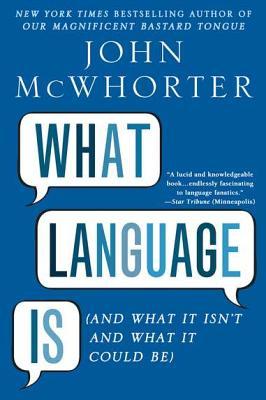
 You know when you meet someone who loves what they do so much that when they talk about it they get so excited about it even though you have absolutely no idea what they are talking about but you are so taken in by their enthusiasm that it doesn’t matter. This is often how I feel when Kate talks about Linguistics. She gets so excited and her face lights up and it’s just so Kate that I want to know what she’s talking about and be just as excited as she is. John McWhorter is the same way. I can feel his excitement on the page as he talked about one language after another. I’ll admit that there were a few things I still don’t understand but I think I get the gist. It’s interesting on how languages evolve and change over centuries. Obviously I knew that the English we speak today is not the English that was spoken in Shakespeare’s day or even Chaucer’s but never really thought about it how we got to where we are now. Basically, adults needed to be able to communicate but were unable to grasp some on the complexities of the language so they simplified it and taught it to their kids and so forth and so on. It’s kind of amazing. I basically learned that the more people who speak a language over centuries, the less complicated it is. If you speak a language that only a few know and have all learned from childhood it’s going to be more complicated it because adults from the outside have little use to learning it to communicate it. I’m probably oversimplifying it but that’s fascinating. He makes arguments for what languages are categorized and how our own biases make us judge languages and what are real languages and what are not. Does it have to be written? Spoken by a certain number of people? Have it’s own grammar? Follow certain rules? All very interesting questions that I really can’t do justice answering but say read the book and get suck into his excitement and enthusiasm while you are at it.
Review: What Language is by John McWhorter
2




 It’s been a couple of years ago that Tahereh Mafi completed her Shatter Me trilogy but I guess she wasn’t finished with it because here we are with book 4. I feel like I should went back and read the original series because there were so many things I forgot about. The one thing I didn’t forget about is how the Mafi’s writing style changed as Juliette’s mind because more stable. As she becomes less isolated and understands her power the writing style because more fluid and less choppy. In this one, as things start to unravel for Juliette and Warner we start to see a return to the choppy phrasing from earlier books. I knew as soon as Juliette’s journal appear that things are not going to end well. Not to get too far ahead, let’s start at the beginning. Restore Me begins a little more than two weeks after the end of the last novel. Juliette has taken over as Supreme Commander of North American and soon discovers she is way over her head. Not only does she know very little about politics but the people she trust have been keeping things from her. Things start to spiral out of control when the kids of the other Supreme Commanders start showing up. Juliette learns that as much as she wants to run from her past she can’t because in truth she doesn’t even know her past and what she doesn’t know just might get everyone killed. I really enjoyed this and I’m glad Tahereh returned this world because clearly there is a lot to explore in Juliette’s story.
 2 Women, So Many Books