I finished my pop culture homework assignment, this month’s book group book, and I’m free! I can read whatever I want! So, I picked up something that was completely different from everything else I’ve read this summer. This book is about a park ranger and an account!
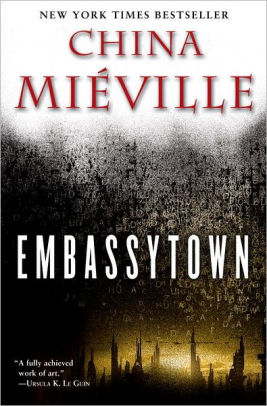
The last book of my Pop Culture Assignment and I don’t even know where to begin. There is a lot going on and I think it needed a glossary for all the new terms he made up for this world. Our Protagonist Avice, is an immerser that knows how to control the immer but it was never really explained what that is but it has to do with space travel. Her ability allowed her to leave Embassytown and return but I’m getting ahead of myself. Avice is from a colony in the middle of nowhere. There lives an mysteries species called the Hosts that have a peculiar way of communication called language. Only few people know and few can speak it. The few who can are Ambassadors are two people modified to think as one. It’s complicated. Avice has a rare place in language as she was once used as a simile. The Hosts can not lie. They can only speak the truth so for something to be said it must has a place in the world so they make people or things a simile to help explain things. It’s very complicated. Anyway, Avice leaves Embassytown only to return with a new husband who is a linguist and seems more interested in language than Avice but whatever. As soon as they return things get crazy. The end of the world crazy. The nation that oversee them decides to bring in their own Ambassador and well, things don’t go as planned and all hell breaks loose.
It was an interesting read but it was very confusing. I felt like so many things that were left unexplained like the immer that we are just expected to understand. Language too is very complicated that it does take the whole book to understand but that also might have been the point. It took a while to get into because the world building was immense and once I got past that I really enjoyed it. I was still left confused on several things but still enjoyed it.
Something that always interests me is how accents or dialects are presented in literature and how those things can act as a stand in for something else (like class or race). I’ve recently finished listening to Cuckoo’s Calling and The Silkworm and two of the main characters, Robin and Cormoran come from places in Britain that are either known for their accents or have some very good reasons why they’d have distinct accents. The standard British accent (sometimes called RP for ‘received pronunciation’, or ‘Southern English Standard Pronunciation’ (SESP), ‘Southern British Standard English’, or ‘King’s English’) wikipedia tells us the standard in the South of England and can be heard all over England and Wales. The thing with standard accents or dialects is: they are fiction. No one speaks them. There are regionalisms everywhere. We all do our own thing. But, we operate as if we’re all doing the same thing so there is power in performing in a way that aligns with the standard. There’s also an invisibility that comes with being in line with the standard. But, I’ll circle back to that. The standard dialect is what you are used to hearing if you watch a lot of BBC television (or listen to a lot of BBC radio). The video below is from a YouTube channel that helps people practice their standard pronunciation. I picked this one because standard British is known for being ‘non-rhotic’ which means that at the ends of syllables and words, r-sounds are not pronounced.
‘Cart’ and ‘Fast’ do not have the same vowels for me. But, they do in Standard British English!
Since neither of our main characters speak this standard dialect and both of them speak a dialect that could mark them as outsiders, so lets talk about what they might sound like.
Let’s start with Cormoran.
Cormoran is said to have a Cornish accent. Cornwall and Devon are in the Southwest of England. There the little sticky-outy bit that is below Wales. So, in the map below, you can see the island of Britain to the right of Ireland. There is a red line around England and a bit in the West that is excluded by the red line. That excluded bit is Wales, Cornwall is below that.
Cornwall is pretty small as a region. It regained its Independence following the Roman exit but eventually fell under the rule of Wessex in the 1300s and was eventually fully integrated into the monarchy. (Thanks, wikipedia!) Cornish, a Celtic language, was spoken in the region and was thought to have died out. But, its undergoing a revival now.
Now, onto Robin’s accent. Ayup! (There’s no way I’m using that right.)
Yorkshire is in the North of England and includes cities Leeds and Sheffield.
Some of my favorite English-isms are apparently from Yorkshire. For example, faffing. As in, “She was taking her time, faffin’ about, not getting much done.” Faffin’ is one of my favorite words. Also, Yorkshire might be one of my favorite English accents. In my mind, Yorkshire is the quintessential Northern English accent. Speakers with this accent have an “i” sound as in “in” at the ends of words like “city” where you might have an “ee” sound. It is a dialect that is known for contractions. For example, speakers may contract the definite article “the” and so something like, “I’m going down the pub.” might sound more like, “downt pub”.
Here you can listen to Yorkshire native Harrison Fletcher discuss his accent.
So, both of these characters have non-standard accents and, in the books, they are definitely set apart from most of the people they interact with. In the first book, they are hired by John Bristow, adopted son of Sir Alec Bristow to investigate the death of his sister, Lula Landry. Throughout this novel, they meet moneyed individuals who sometimes go out of their way to make it clear that they are from a different class and their betters. Nowhere is the contrast more great than between Cormoran and his ex-fiancé Charlotte Campbell, whom he met at Oxford. Charlotte is a blue blood and, if I’m being honest, also the worst. Robin does a great job of hiding her accent, but it does come out at times. I found it a really wonderful addition to the book, reminding you that both of these characters are outsiders in the city of London, which is perfect as they investigate their cases.
This has been just a very brief look in at these accents. If you want to have a deeper look, you can check out the BBC Voices project, which can be found at the British library. (Here’s a link to a conversation with folks from Penzance in Cornwall and another one from Bishopthorpe in Yorkshire.). There are also some nice slide shows on Slide share, such as this one by Natalia Ramirez. The Dialect Blog has a post on Cornish accents. And, of course, Harrison Fletcher has a few videos on Yorkshire English.
This is a book club selection. I have no idea what it’s about, but knowing the people in the book club I am pretty sure I’ll be sobbing at least once during its reading.
In the novel Scowler by Daniel Kraus, meteorites hit Iowa farm country and all hell breaks loose. Except, that’s not what the book is about. The book is about how Ry Burke comes to terms with the trauma his abusive father inflicted on his family prior to being sent to prison. The entire book takes place in the hours immediately before a meteorite impacts the Burke family farm and also the subsequent day. It’s a pretty intense day, as it involves both a meteorite and facing Ry’s escaped-convict father, Marvin.
This book is so intense. So, so, very intense. Now I know why Beth said, “I really hope you don’t hate me after this.” So intense. So, some content warnings: This book involves some pretty detailed descriptions of violence and abuse. It was so, so brutal. The book spiraled into insanity that was both useful and hellish.
I liked Ry and Jo Beth. I thought their characterizations presented them as full people. The writing would veer into the thoughtful and touching before winding its way back into horror. Sarah, Ry’s younger sister, is also pretty great. Marvin Burke is even presented as a full person. He has moments of humanity that make the violence seem even worse.
This book, man. It was good, but it was also very horrifying.
This is it! My last book of the Pop Culture Homework Assignment! I was so excited when I got it from the library (from a branch I’d never been to, no less!) I texted a picture of it to Beth. And she responded by saying, “I really hope you don’t hate me after this”.
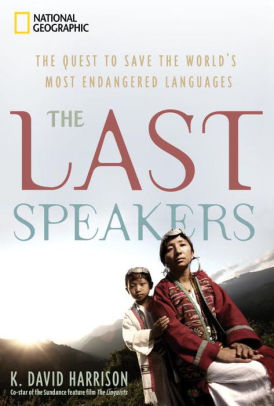
My pop culture assignment from Kate is to delve into her world as a linguist. Linguistics has been referred to as a social science. What does that mean exactly? The first book, What Language is by John McWhorter was more of the scientific side of the linguistics, explaining what they look for when they study languages. How languages are built and how they became to be and continue to develop. The Last Speakers is the social side of linguistics by discussing why the study of languages are important to understanding who we are and the world around us. Both aspects are important to discover how we communicate to each other. K. David Harrison set out to study endangered languages because the knowledge of the natural world they contain that we have lost by no longer speaking them. He learns from indigenous people words that describes the world around us. How they can speak or sing to animals to get them do what they need them to do. Plant life that are now extinct. Medicinal methods that have vanished in the wake of modern medicine. If we lose these last speakers we lose more than just a language being spoken. We lose a great deal of our own knowledge of our world that we will never get back. The book reads like a travel memoir as he details his work around the globe but it’s also a plea to the world to not abandon these languages. He and his team document these languages and do everything then can to keep these languages alive long after the last speakers pass away but also bring to light new or remembered words of our past. I like that he isn’t to be the white savior. He goes to observe and document and help where he can. He defers to the people in how they want to documented. Not all people want their languages to be shared with outsiders and he understands their reasoning without judgment. It’s their language and culture and they should have the final say on who gets to know it and learn it. It was an interesting book, with some great stories and I’m fully support more documentation of last speakers from all over the world. We have so much more to learn.

 The last book of my

 My pop culture assignment from
  2 Women, So Many Books