Series You Should Check Out: The Goddess Wars by Kendare Blake

Featured image

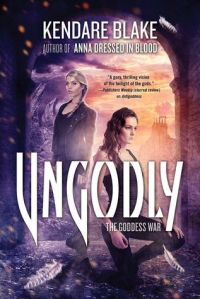
Ungodly is the final book in the Goddess War Trilogy.  The Greek Gods may not be worshiped like they did in Ancient Greece but being Immortal, they are still around and living mostly normal lives.  That is until they mysteriously start getting sick.  Gods are not supposed to get sick but Athena is coughing up feathers, Hermes is wasting away, Aphrodite has gone mad. Artemis is perpetually being hunted, just name a few.  Athena and Hermes set out to try to figure out what is going on.   This leads them to find the mortal heroes from the Trojan wars, Achilles, Odysseus, Hector, Cassandra and Andromache.  The thing is that they are now teenage kids who have no idea who they really are/were or are just waking up to it.  Only thing they know is that they are in a world of trouble.

I like this series because it was fun to read but also an interesting take on Greek Myths.  These Gods and Goddess are not Greek Gods of Rick Riordan.  They are not all gathered in one place on Mount Olympus at the Empire State Building keeping tabs on the world below.  They are scattered about the world with litter to no contact with each other.  They have gone on living their own lives and well still holding the same grudges for thousands of years.  Also the threat of dying has really humanize them in ways they never could be before.  They learn what it feels to live with the uncertainty that they will live to see tomorrow.  As for their human heroes, the Gods, particularly Athena and Hermes, find they are more sympathetic to them.  They are not just weapons to be used when needed but actually people with actual lives.

Cassie is really Cassandra who was a oracle during the Trojan War that Apollo cursed that no one will believe her.  Now in modern day she’s just Cassie who is in love with Aiden, oblivious to what’s going on until she meets Athena and Hermes.  She finds out that not only she a character from the Ilaid but so is her brother Henry (Hector) and her best friend Andie (Andromache). Oh and Aiden is actually Apollo, who feels really bad about that whole curse thing.  Considering the past run in the Gods didn’t go so well, you can probably bet that they aren’t going to get along all that well in the present either.  I definitely love how all of them at one point or another stand up the the various Gods.  They don’t just fall in line and do whatever they are told do.  It takes some major gumption to stand up to Athena. They each are in various states of conscience of who they were and they each have to figure out who they are now.  Do they just except that it is their fate to relieve the same drama all over again or do they choose their own path?  Isn’t that what we all struggle with?

There is a lot of action throughout the series.  Gods taking on each other.  Of course, Hera is a villain, when isn’t she?  You almost have to feel sorry for Hera.  She is constantly playing the villain.  To be fair, she did do some pretty terrible things but to be also fair she also endures some pretty terrible things too.  Anyway, total side note.  There are a lot of twists and turns and not afraid of killing off characters for the sake of the story.  It’s fun read for all those who love Greek Mythology, kick ass heroes and heroines and action.

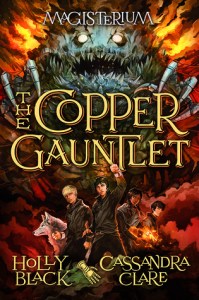
Quick Review: The Copper Gauntlet by Holly Black and Cassandra Clare

cooper gauntletI often forget about how dark children’s literature can be.  Take for instance, Matilda or any Roald Dahl. Harry Potter, The Series of Unfortunate Events and Alice in Wonderland to name a few. Black’s and Clare’s Magisterium series is no exception.  It started with the ending of the first book where *Spoiler Alert* one of heroes turns out to be the bad guy and just continues from there.  Call, Aaron and Tamara are thrown into situations that are really well beyond their ages but do it anyway.  They all young and just coming into their own, discovering who they are and learning to control their powers.  They are trying to learn who they can trust because even the adults are a bit sketchy.  After the big reveal at the end of the last book I had big expectations for this one and for the most part it lived up to it.  I still felt that it started off slow, much like the first one did but once it got to the mission it was a fast read.  If only the whole book was like that.  I like the debate of nature vs. nurture that is being played out with both Callum and Aaron’s characters. I have a feeling that we are about to see a little role reversal with those too.  It’s a solid second book and I look forward to see what happens next.

This Month in Reality…Waking Up 

I have been continuing my meditative practice and reading more on meditating this month.  The good news I’m getting better.  The bad news is I’ve gotten to the point where I know I’m getting better because I’m completely aware of how very, very bad I am at it.  The author of Waking Up tells me this is a real sign of progress.  You feel like you’re getting worse because you were so sure you were great at it before.  But, now that you have a little practice of recognizing a thought you realize that you were just telling yourself a story before and you weren’t actually all that awesome.  

So, that’s a total bummer if even if it is also a total victory.  

Waking Up by Sam Harris is a book about spirituality for the non-religious.  The thesis of the book is that spirituality is something human and that if we package it with religion we are missing out on something that we all need.  Specifically, religion and spirituality have traditionally been places where we have cultivated consciousness with meditative practices that leave us calmer, more focused, and feeling better about the world, ourselves and others.  Compassion, focus, these things can be taught and some traditionally religious practices can help us learn.  Meditation, particularly if you think of it as a Buddhist practice, is an excellent example of this.  There are other examples, too.  Prayer seems to be a meditative practice for many people.  But, if you don’t believe in God and/or you don’t want to follow or adhere to a set of guidelines or rules prescribed by a religion, you could still probably benefit from similar practices.  The book focuses a lot on meditation practice and how meditation can help us cultivate consciousness.  
Harris says throughout the text that he doesn’t want you to take him at his word.  He wants you to test out his theories and ideas in the ‘laboratory of your life’.  And, I liked that.  I liked that a lot.  I like being encouraged by someone selling an idea to try the idea on to see what I think about it.  I also liked that Harris presented some research on consciousness and how what we think of as consciousness relates to our brains.  This is an area of much ongoing research because we don’t know where consciousness is (if there is even one particular where to pinpoint, which there probably isn’t.)  Some of the research he presented in this book is on split-brain patients (note: this stuff is *not* for testing in the laboratory of your own life).  Split-brain patients have had their Corpus Callosum severed.  This is done surgically (as a last-ditch effort to stem the tide of epileptic seizures that are devastating other neurological processes or for other equally serious reasons) and after the procedure the hemispheres are cut off from each other.  This leads to some interesting behavior like the right and left hand both reaching for the same object.  Or, the right and left hand picking out different outfits to wear. These are really interesting studies and if you’ve never read about split-brain patients before this alone might be worth the price of admission.  
I really enjoyed this book and if you are interested in meditation practice or spirituality but can’t handle religion I’d say this isn’t a bad place to start.  

I checked this book out from the Buffalo and Erie County Public libraries