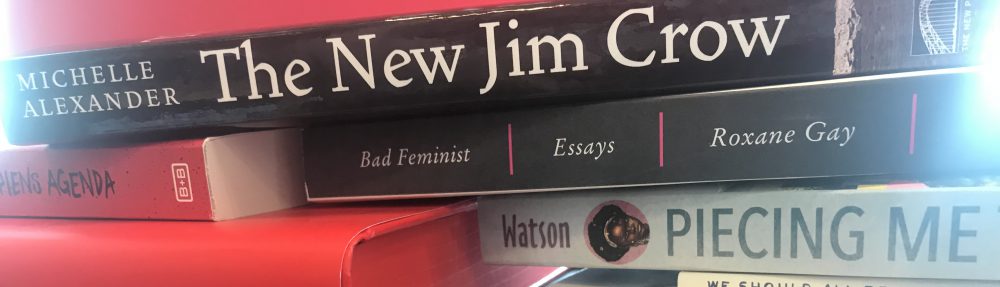
 Today is the last day of February and as such the last day of our group read of John Lewis’ March. Were you able to finish all three volumes of March? What are your final observations? What will you take away from John Lewis’ story? I was really moved by his story but it also illustrated my own privilege. There are many small things that I have taken for granted. Obviously, I was raised in a different time and place but I’ve never had to worry about where I had to sit on a bus or be concerned about what truck stops to stops at when traveling with my family. My life would never be threatened because I wanted to register vote. Even now,. as more and more states tighten of voting laws, I don’t feel that my constitutional rights will be threatened but I do worry for minorities and marginalized groups having their rights stripped away. We have not come as far as we think we have. Old prejudice are hard die and I worry about how much farther we will fall back. It’s also makes me think about what I’m willing to go to jail for or willing to be beaten for. I’m not really sure. This year, I’ve already participated in my first protest march and have called my Congress representatives more then I have ever in the past. I’m not sure I have the bravery of John Lewis and Fannie Lou Hamer, Rosa Parks and so many others. I seriously hope that it won’t come to that. That we will be able to keep our protest peaceful and those we opposed will to as well. The importance of this book is so we don’t forget the mistakes of our past. To remind all of us about our history so we are not doomed to repeat it. Knowledge is truly power.
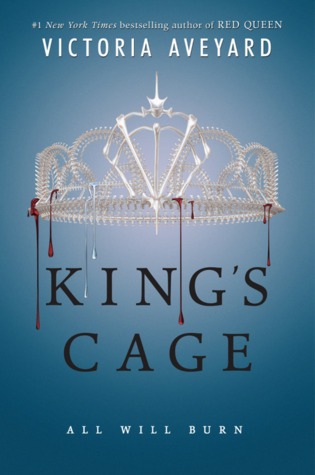 You know that moment. That moment when the main character makes a declaration statement that you can’t help but groan because you know they are just going to be disappointed. Yeah, that happened about midway in this book and yeah, Mare was crushed when she found out she was wrong. It wasn’t all that big a surprise because it is the third book our of four, so there still needs to be some drama left. She couldn’t be set in romantic life so soon but it was also like, C’mon Mare! Haven’t you learned anything yet!? Anyway, I think I’m getting ahead of myself. King’s Cage was another fast paced thriller that fits in nicely with the previous two books. Mare begins as a prisoner of Maven, who is using her as a propaganda against the Scarlet Guard. As Mare is imprisoned she battles Maven in an emotional tug of war. She is shackled in silent stone manacles, depriving her of her power and making it impossible to fight back. Her only weapon is to use what she knows of Maven but this is not easy because her own feelings for Maven are complicated. The first part of the novel was interesting as Victoria explores the effects of abuse and can you be held accountable. This is an addition to previous themes of what makes a person a monster. Mare is scared that her powers has made her cold and heartless, to easy for her to kill someone and move on with her life. Thanks to Maven’s mother, he doesn’t have those thoughts because so much of his memories she took away from him. She took away his fears and love of his father and brother. I’m not even sure what you call this abuse. She literally molded him to be the cold killer he is today. The only sense of humanity he has is obsession with Mare but even that has been twisted. Cal on the other hand is still Cal. While he has shown some growth over the novels, he isn’t quite as developed as a character as Maven is. There seemed to be a change in him as he seemed to be turning around about the Scarlet Guard and what they are trying to achieve but the first chance to return to his old life is presented to him the seems to have taken it. The book is still Mare’s story but as the conflict expands beyond her, we are given new Point of Views from Cameron and Evangeline. This is a welcome change as all three woman are different and come at the conflict from different views. They obviously see this conflict from different point views but they all think they are in the right. My one grip with this book was the ending. After pretty cool cliffhangers of the first two books, this one sort of fell flat to me. It wasn’t the game changer of the others. Sure, it assured that Mare was going to have to stand on her without one the Princes beside her but it was also predictable. I guess since this is what is leading us to the finale, I wanted it to be more. That being said, I am super stoked to find out how this series is going to end.
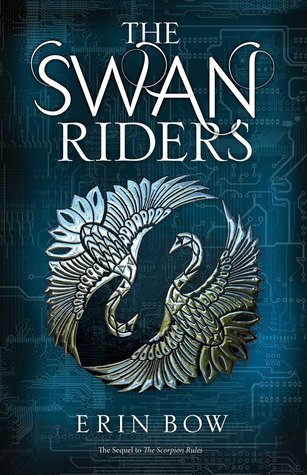 The Swan Riders is the sequel to The Scorpion Rules that I didn’t even know existed until I made a little trip to The Strand last year with a friend. When I saw it, I knew I had to buy it. The Scorpion Rules was one of the better books I read in 2015. It’s yet another dystopian novel but this time with a very sassy AI. It takes place about 500 years in the future after several devastating natural and non-natural disasters. The biggest problem is a shortage of water that has lead to several violent wars. So the U.N. decided to appoint the A.I. named Talis to come up with a solution. His solution was to go all medieval on the world. Every government must give a child as hostage and if they open war on another nation, the hostage dies and oh, a city is going to be blown up too. At the end of The Scorpion Rules, our heroine Greta, the crown Princess of the PanPol Confederation that covers Canada to Great Britain, volunteers to become an A.I. not save herself but also save Elian, the hostage from the neighboring country that openly declared war on her nation. It turns out that turning Greta into an A.I. doesn’t sit well with a lot of people. The new King of PanPol Confederation refuses to give up a new hostage to replace Greta and soon rebellion starts to take hold. As for Greta herself, the transition from human to A.I. isn’t an easy process. In fact no many new A.I.’s survive the first couple of days so it’s a race to get Greta to the home of A.I. across Saskatchewan through an open rebellion. The thing is the rebellion isn’t from the people Talis thinks it from. Talis, Greta and two Swan Riders race across the country they are attacked and Talis is gravely injured. Now they all must figure out why he was attacked before he dies and the city of Halifax is destroyed. In way they have to convinced an A.I. to be more human and a human to be more A.I to change the world. I’ll admit that I liked the ending of the first book. I liked the open ending so when I did see the sequel I wasn’t sure how I felt about it beyond I had to read it. This wasn’t as good as the original but it was still good. While The Scorpion Rules was fast paced, this one was at times a little sluggish. It just didn’t have the same flow. While the main theme of this one is what makes us human and if we take out our human emotions from solving our problems then when do we cross the line of turning into a monster. Can you really have peace through terror? The threat of killing off a hostage or destroying entire cities hasn’t stopped countries from declaring war on another. Maybe there are less conflicts but I wouldn’t say this world was peaceful by any means. So while Talis rule may have saved billions people statistically but it hasn’t changed the world for the better and everyone needs help now and then.
 2 Women, So Many Books