Assigned Reading: Frankenstein by Mary Shelley and The Importance of Being Earnest by Oscar Wilde

Very occasionally, the interests of my work life and this blog align. This past year, it feels like that has happened more than any other time in career. I’ve been teaching some new-to-me courses in a different department than my home department, teaching some required general education Humanities courses. This has been delightful. I’ve gotten to interact with many students I would have never had the chance to interact with. And I’ve gotten to read (re-read) some classics, some foundational texts, and some big-named thinkers. The Humanities are important because we are important, to ourselves and to each other. These courses I have been teaching allow students to practice important skills around critical thinking and effective communication, but they also give them space to really consider big concepts that loom in the background of our days and define them for themselves. It seems silly to ask, in part because it is so ubiquitous, but what actually is ‘modernity’? Or, ‘progress’? How about ‘what does it mean to be American?’ But the answers to these questions can have very real world consequences. Definitions of modernity can classify useful and important things as out-dated and old-fashioned. For example, do students need writing skills or do they just need to know how to use AI templates? Definitions of progress can have huge impacts on what we require of students, what we expect from companies, what our government’s policy goals are. When we decide what counts as progress, we decide what our priorities are. For example, is generative AI progress? And for the impacts of what it means to be American, you can look at the headlines. The courts are debating who actually falls under birthright citizenship right now.

A man looks at his reflection in a pond. Text reads "Mary Shelley" "Frankenstein: the 1818 text"
Frankenstein by Mary Shelley

Two times this Spring, I had the opportunity to revisit classic works in the course of my teaching.The first is Frankenstein by Mary Shelley. I dug this out of the back of my bookshelves from when I was an undergraduate. This classic novel is a seminal work in sci-fi and horror and tells the story of Dr. Frankenstein, a man who never once stops to ask himself if he should, just because he can. I have discovered teaching this book (and from interactions that I’ve had with people on fable), that if your only reference to Frankenstein is pop culture, that you might be expecting this to be centered around the monster. And, it is, except the monster isn’t the creature. Dr. Frankenstein does this massively unethical breakthrough science and then fails, repeatedly, to take responsibility for the consequences of his work. Even though this was first published in 1818, it still feels very relevant to me. A perennial topic for opinion pieces (and for my student’s writing this past year) has been the cultural divide we are seeing and the idea that many of us are living in an echo chamber or are siloed off from ‘the rest of the world’. Dr. Frankenstein lives in this bubble where he thinks about his ideas and how to apply them and then doesn’t step back to seriously consider the implications of those applications. This is a theme that my students have been picking up on and that really resonates with them. It’s like voting for a politician because you like one idea that politician discusses without considering what that would actually mean for their own lives.
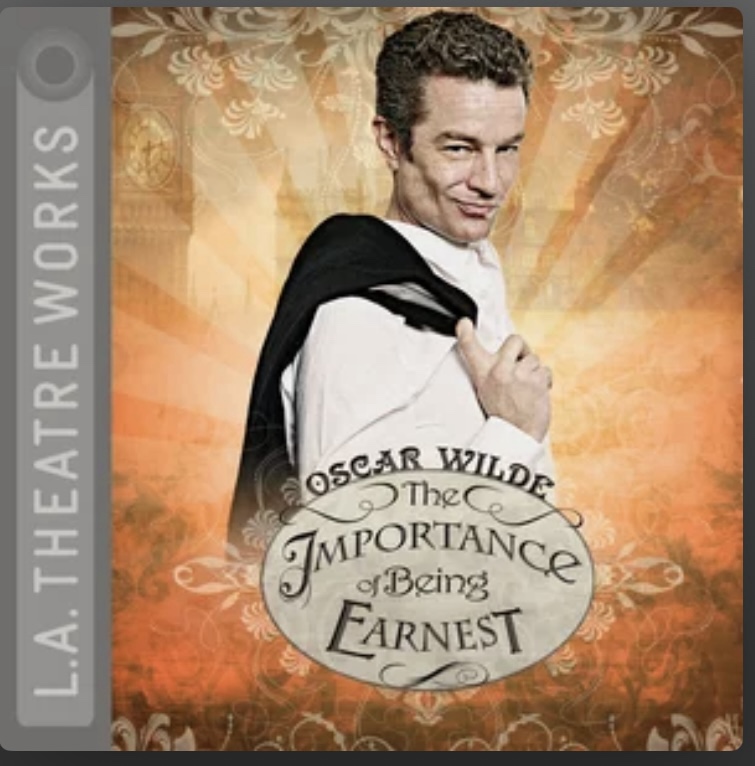
Man looks at the viewer with a jacket draped over his shoulder while facing right on a orange background. The text reads "The Importance of being Earnest. Oscar Wilde"
The Importance of Being Earnest by Oscar Wilde

The second overlap was The Importance of Being Earnest by Oscar Wilde. I listened to the L.A. Theatre Works production that I got from my local library.This is such a fun play as Wilde pokes fun at Victorian sensibilities and their obsession with appearance by punning off the word “Earnest”. In the play, two men discover that they are both playing similar games. They have a secret alter ego that they are always in need of rescuing that allows them to escape from the seriousness of their lives. This backfires a bit they fall in love with women who are both smitten with ‘Earnest’, one of the secret alter egos. This play is so silly and so fun, but it also something that my students have really enjoyed digging into. As largely members of Gen Z, they have grown up with the internet and very aware of what its like to live in a time that is utterly obsessed with appearance. For them, it might be how they express themselves on social media, but they still are able to draw parallels with the Wilde text.

It is a delight to be able to discuss reading with people who don’t always identify as readers themselves. Beth and I are obviously into reading for fun, but not everyone is, so their perspectives on classics are informed by other things beyond the written word. And it is always interesting to hear what people have to say about the connections they make between classics and their lives. It is also so important to connect with people and to think about big ideas. When we get caught up in the details of our lives (bills, health, jobs, family, etc.), we don’t always leave ourselves time to think about things and enjoy ourselves. But we should, because our humanity is important.

This Month in Reality: Book lists and Syllabi

A lot of terrible things have happened…well, all of human history might accurately categorized as action and reaction when terrible things happen. One of those actions that people can take is educating oneself and trying to be a better person and/or not be as much a part of the problem. I have been heartened to see what might be a new trend in book lists: the syllabus. (Can a tool for teaching in the classroom be thought of as a “new” trend out of the classroom?) I am always happy to see thematic lists and I’m always looking for new things to read, so I have been collecting them. Some of the following are actual syllabuses for college courses and some of them are just curated lists on a topic. I’ve got them and I’ve been looking back through them now that I’m aware of how far behind I am on my reading challenge. While I was looking at them, I thought I might share them with you.

This first link is an in-depth list but together following the mass shooting in Charleston in June of 2015. This list is amazing in its detail. It provides historical context starting with a general overview before readings on slavery in both the North and the South before going onto the civil war, reconstruction, and Jim Crow. There are readings on race and religion. There are readings on white identity construction and white supremacy in the US and abroad.

The next syllabus I have to offer is the Black Lives Matter 2016 Fall Syllabus. This syllabus was put together by Professor Frank Leon Roberts at NYU for a class. This is a nice syllabus because it includes not only papers and texts to read but it also includes videos and films to watch. The syllabus also includes writing prompts for reflection papers, so while you are reading and watching, you can also do some digesting.

The Standing Rock Syllabus, put together by the NYC stands with Standing Rock collective includes readings on topics like settler colonialism, the histories of indigenous peoples in North America, environmental racism, and readings on Indian sovereignty and treaty law.

The Lemonade syllabus grew out of a desire that many people had to understand and better get all of the references in Beyonce’s visual album Lemonade. It was put together by Candice Benbow and is beautiful. It is stunningly laid out, once you’ve followed the link from the site. It is 36 pages and includes space to make notes and to write down the date when you finished reading. The syllabus is divided into topics that include (but are not limited to) fiction, non-fiction, black feminism, womanist theology, photography, music, critical theory and poetry. It is so cool. People had questions, they took to twitter and using a hashtag gave each other answers.  I cannot understate how in awe of this syllabus I am.

The Luke Cage Syllabus is a look at the literature in the netflix show Luke Cage but together by Tara Betts at Black Nerd Problems. These are books that are seen or referenced in the show. This syllabus is my convenient excuse for re-watching the show.

These last two I haven’t had a lot of opportunity to look over yet. One of them is a google doc and I’m not sure who it is edited by but it is a reading list for white people who want to educate themselves so that they can be more informed. It is divided up thematically and includes readings on systemic racism and racist ideology, the history of black lives matter and readings on steps you can take to combat racism. The last one is from Haymarket books and is called the Stop Trump Reading List. This list contains books that talk may help you understand how Trump was elected and it includes a link to a list of books especially for young people.

So, there you have it. Syllabi and reading lists to help you find your next book(s) and  to learn a little about issues in the world and also about references in pop culture you may be missing!

If you have any suggestions or have seen any reading lists/syllabi out there that I missed, please take to the comments and let me know!


World Aids Day

Today is World’s Aids Day and Giving Tuesday.  So in that spirit, I hope that you will join me in supporting this Kickstarter.  It’s by my friend Bill Bytsura.  He hopes to publish his book of portraits and stories of Aids activists he collected from all over the world between 1989 to 1998.  These are stories of those who fought from the beginning and deserve to get the recognition for their work to help fight this disease.  For more information on this project and Bill go to www.theaidsactivistproject.org

Thank you for supporting and spreading the word.  How ever you spend to day be generous.  This is the time of year of giving.  So give what you can, whether it’s to this or another project that is close to your heart.

Adults, Teen Books, Important Conversations, and Our Responsibilities

I’ve been reading a lot about John Green and the accusations of sexual abuse and since I’m already on record as saying I don’t like John Green (the persona, mind, not his writing) I’m thrilled to itty bitty pieces that the authors of twitter have already stepped up to defend John Green and I dont’ have to. But, the original tumblr poster made non-sexual abuse claims and they need to be addressed.

First, in case you missed it, tumblr user virjn posted on tumblr that they thought John Green was a creep. Then, a bunch of people reblogged it, someone added something about John Green being a pedophile. John Green was tagged in a reblog. And, then John Green responded by saying that he does not sexually abuse children. Which was a libelous claim and I’m willing to believe that he’s telling the truth. And, it’s totally not the thing I want to talk about. I want to talk about the original post, the post that was hijacked by people who are in love with the outrage cycle or are just trolls or are just terrible people. (The hijacking itself is probably its own post but I don’t want to talk about that, either.) I want to talk about how the original poster and their feelings that John Green is creepy. John Green’s online persona squicked this person out enough that they posted about on tumblr. And, it is probably a fair bet that other men, young and old are doing the same thing and don’t understand why women find them off-putting.

Everyone who saw the original post missed an opportunity to explore why John Green sometimes comes off as creepy. And, before you say, “If you don’t like it, just unfollow John Green.” And, you’re right. On the internet, that’s an easy option. If John Green is making you uncomfortable, don’t read what he posts. But, people are going to creep you out and you can’t always ‘unfollow’ them. So, exploring why people creep you out and what other things that can be done about it is invaluable.

Sometimes people make us feel uncomfortable and we should trust those feelings. We might even want to try to figure out why we have those feelings and what can be done about it. Art, literature, and the media we consume give us opportunities to explore situations and life experiences that we might have an interest in. They also give us an opportunity to explore feelings that we might have. An important part of creating and consuming art, literature and media is the need to critique it(and John Green’s internet persona is something that is different from him as a person and so I’m considering it worthy of critique). We need to thoughtfully engage not only in the creation of things but in considering the pros and cons of things after they’ve been created.

As Teresa Jusino of The Mary Sue noted, John Green could have read the comment and said, “right, okay. I didn’t intend for you to feel this way. Your feelings are valid. Let’s talk about this.” John Green, as an adult who writes books for teens, had a tremendous opportunity to start a meaningful conversation about unequal power dynamics, feeling uncomfortable, and how to deal with it. He missed it. The other authors who came to his defense and shamed people for making light of actual rapes and sexual assault missed an opportunity As Camryn Garrett HuffPo noted, we may have just told a young woman not to trust her feelings which might lead to terrible future consequences. (That HuffPo piece is a great read, by the way). This isn’t necessarily on the authors to do this work. They aren’t responsible for always being their to listen and direct their fans. We, as adult readers of teen books, need to make sure that we are not missing these opportunities to have meaningful conversations when they come our way. We might not create the art, but we consume it and our lives create the contexts that the art exists in. As adults who read teen books if we do anything, we should be doing what we can to make space for teens in our conversations so that they can thoughtfully explore art, literature and media and have good examples of how to respond when something is problematic or makes them uncomfortable.